Most Popular

Showing posts with label culture. Show all posts

Saturday, June 30, 2018

Facebook Suggestion Post #3

Even though we are not currently in the Philippines, I planned on writing a culture post and what better way to do that than to go all the way back to my facebook question from April of 2017 when I asked for questions that American may have about the culture that I, from my vast storehouse of experience with the country and culture, am able to answer with ease in roughly 500-700 words.


This suggestion comes from a certain Robbie Waller, who would like me to write about the need for Walmart in the Philippines. 

In some sense, the Philippines would benefit greatly from Walmart. People would be able to get everything they need (and a bunch that they don't need) in a convenient one-stop-shop. People would have everything they need for fixing things and not have to jerry-rig the things that are broken. But in other ways the Philippines does not need Walmart. I think that while yeah, of course, obviously, it would make shopping easier, it would also do something horrible to the culture of the Philippines. The way I see it,  Filipino people are some pretty resourceful men and women. They have lived through multiple centuries of being subjects to other countries, influenced by still others, and now they are (from what I can tell) in transition still. In some ways the vast majority of people are still trying to figure out what it means to be Filipino, and what exactly being Filipino entails. This transition and influence has caused Filipinos to be very resourceful and to look at problems and challenges from a very different perspective.
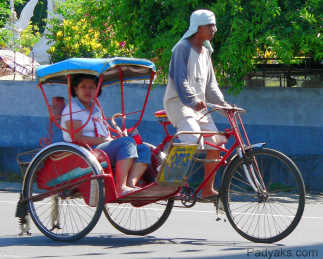
Their resourcefulness comes through in a myriad of ways, but it is most easily on display when you are in the market area. There you have the convergence of the two big aspects of the culture: the farm and the city. You see farmers who live in simple wooden houses in a village with a dirt path for a road who get up ridiculously early to catch a jeepney (with all their produce) into the city so they can get to the market to their stall. You see the pedicab driver who is sweating profusely under his shirt that he has wrapped around his head to keep the sun off with some knock-off Ray-bans to keep the sun out of his eyes riding around on his rig (decorated with colorfully recycled items) looking for passengers. All over the market area you see this resourcefulness and for an American who is "fresh off the boat" it may seem almost sad and disconcerting, seeing as quite a bit of the need for this type of resourcefulness is due to poverty, simply having to recycle and reuse items because they can't always afford new things. Down the street, near a school, classes have taken to recycling soda bottles for gardening, and ingeniously saved space with the planting of flowers and herbs. 

Now, here is why I think that having Walmart would be horrible for the Philippines: If we as Americans move to a small town and for some reason unknown to mankind, there is no Walmart, then we may seriously wonder how in the world we will survive. We may wonder how in the world we are supposed to buy groceries or car parts or movies or furniture or home repair supplies or any number of other goods and services. The Philippines has a few malls that have their own department stores and grocery stores inside that do function in some ways as a one-stop-shop, but these are out of the budget for quite a bit of the country. But even middle class families (and I'm sure upper class folks too) have a vein of resourcefulness inside, and they often don't seem feel lost and adrift in the world when stuff breaks or they need a quick fix for x,y, or z. Americans tend to, sans Walmart. Filipinos, in some sense, are free from the reliance on big stores like Walmart to provide all they need or want. They are able to get things done without the need to run to the big chain stores to make sure they have exactly the right tools or supplies. Don't get me wrong, there are specialty shops for bike parts, hardware stores, etc. and people will go and get what they need from these establishments if they need to. But it seems like if, in a pinch, something needs to get fixed and you are in the jungle on a dirt path and your bike breaks down, well...you simply deal with it how you can. More often than not, it works out. If it holds together long enough, you can indeed go to the bike parts shop to get the parts you need to make the needed repairs. But the resourcefulness of the average Filipino is quite impressive, and it is because of their attitude towards recycling and reusing items that I think that Walmart would actually take something away from the culture. 

Friday, November 3, 2017

Undas and the Reformation in the Philippines

As most everybody knows, this week celebrated the 500th anniversary of when Martin Luther posted the 95 Theses on the door of the castle church in Wittenburg, Germany. The Protestant Reformation was kicked off from this otherwise normal event, as Luther and the Roman Catholic magesterium (popes, cardinals, bishops, so on) dug their heels in over the argument over the gospel and the final authority in the church. To Luther and the other Reformers, the Gospel was buried underneath all the junk of Roman Catholic tradition that had accrued over the years, with the teachings on indulgences and purgatory and the selling of "grace" by the popes being some of the most obscene displays of any sort of religious leadership, and it is the mess with indulgences that actually prompted the 95 Theses. Pressing into the conversation about church practices led to conversations about authority within the church itself. Luther began making arguments from Scripture and reasoned that practices or teachings that were not in the Bible need to be gotten rid of as they pollute and mess up the worship of God and how Christians practice their faith. The Catholics were swinging hard for the opposite: the gospel was not based on grace and faith alone but on the dependence of the person on the grace to be dispensed by the Catholic church itself. This also made sure to vest final authority not in the Bible, but in the Pope as the one who was in possession of the keys of the treasury of heaven, able to dispense grace as he saw fit. 

It's odd that from our vantage point here in the Philippines I see (at least on the Internet) calls and questions about what the Reformation was about and if it is still a thing that is needed today. The questions and posts go like this: Catholics and Protestants believe basically the same things right? I mean, they both say they love Jesus and believe that it is by grace through faith in Christ and His work on the cross that we are saved, so it's all good! Besides, aren't there other things that we need to worry about right now like all the racial issues and abortion and radical Islam and radical atheism and the moral decline of the country and North Korea and that America is looking less like a Christian nation and looking more like....well, who knows! Aren't all these things more important than squabbles over doctrine and practice? Isn't the overwhelming situation in the world excuse enough to excuse Protestants and Catholics from arguing over something that happened 500 years ago so that they can band together and fight the culture war together? 

There have been others, much smarter than me, who have dealt with this question. I'm not worried about all that now. Not really. 

I think about the question of if the Reformation still matters as I ride in a tricycle that has prayer beads hanging right in my face. I think about the Reformation when I walk into a store and they have a small shelf with candles and a figure of Santo NiƱo so that they can gain his blessing in their work. I think about the fact that while Halloween has come and gone people here (Catholics and other Christians) are celebrating the festival of Undas. 

This week school is out. People are off work, and it is the time of Undas here in the Philippines. The whole country has the week off because of this three day holiday. It may not be as flashy as Dia de los Muertos in Mexico, but Halloween, All Saints and All Souls Day(s) are a time when families go out to cemeteries and remember the dead. That in and of itself is not that bad or problematic, not at all. But they will take food and drink out to their departed family members and have a meal with them. They will say prayers for the dead, they will spend the two days at the grave site communing with their dead. Sometimes they do try to get an indulgence (still on the books in the Catholic church!) for their departed or say a Mass for the dead. But the streets are almost empty, as hundreds and hundreds of people go back to their family hometown so they can visit the resting places and offer sacrifices to the dead so they can intercede for the living. 


So I don't really wonder about whether the Reformation is over or not, or whether or not the differences between Catholics and Protestants matter or not. Of course they do! My family and I currently live in the "most Christian country in Asia" that is a modern pre-Reformation Europe, in some small very rural areas the Bible is still located only in the church and the priest (when he is there) is the only one able to read and interpret the Bible for the people in the pews. The situation here is one in which what looks like work among an already "Christian" peoples is really work with pagans that pray for and to the dead, offer them food and drink, worship statues of people rather than the God who created them and think that by doing all of that plus other good works gets them into heaven. So we are working here among people who are believing a false Gospel (which Paul says is no Gospel at all!) and trying to get the few churches that are here and evangelical to get outside their own doors and preach the Gospel and hold out the true hope that they have found in Christ and His blood shed on the Cross! 

So while some of us did celebrate the 500th of the beginning of the Reformation, we don't have to ask if it is over, we know it's not. We have the Word of God in English (and Cebuano), and we don't say the Mass every Sunday, and we get both the Cup and the Bread in the Lord's Supper, and we don't pray to the dead begging them to pray for us, and we (most importantly) have all of this because the Gospel has freed us from the legalistic bondage that worldly religion tries to tie us to, we have experienced the freedom that the Gospel brings us and we see the world through this lens. 

Pray that the people here in the Philippines would also learn to see this way. Pray that they too would get all that we have, not because we are better or brighter than they are, but because we have heard and we have tasted and seen that our God and His Gospel is good. 

Friday, October 27, 2017

Facebook Question #2

A while back I asked on facebook for questions for us to try to answer regarding Filipino culture. This, that's right, is one of those posts. This one right here, as you can tell by the title, is to answer question ang numerong duha (that's number two!)!

This comes from Judy Russell. She asks if we feel secluded due to our language differences.

This is a fantastic question, and the answer will take us about eight months back, all the way to February...

When we started taking language classes way back then we knew very little Cebuano, and I mean basically one or two phrases. And we later found out that we were using them horribly incorrect. We went through the course of material that our awesome teacher patiently guided us through in about 7 months, while the course is intended to take closer to a year or year and a half, if you really pace yourself (imagine a fire-hose attached to a hydrant, now rip the hose off and drink straight from the hydrant). We did learn quite a bit and are now going through the process of relearning more of the fine points that we may have missed in those whirlwind months of study.

I would say that with the level of language that we now have we can communicate fairly okay with people here. We're not as good as we need to be, no way near, but we have had times where we have been able to lead Bible Studies and share the Gospel in full-blown Cebuano, or have normal-ish conversations. Sometimes it feels like we are clicking and everything is firing on all cylinders and other times we have to sit and think and write out what we are going to say before we say it. It's really like when you are in line to order some food and you know what you want and you rehearse it five times in your head before you get up to the counter to actually order.

Yeah...it's like that.

But now, after all of the language classes that we have had, would I say that we feel secluded because of our language differences? In a way, of course! No matter how long we live here and get more and more proficient in speaking the language, we will always be missing out on idioms or figures of speech that native Filipinos will use. Or the speed in which some people speak will just be too quick for us.

A tip when speaking with someone who is learning English: Slow down, don't get loud! They aren't deaf, they just can't catch all you are saying because you are talking so fast.

I would also say that, in another way, we don't feel as isolated as we maybe once did. We are able to communicate on days when we have our thinking caps on. When we don't have a rough switch from thinking in English to thinking in Cebuano then it's usually (sometimes) fairly straightforward to communicate with everyday folk we run into. Even if we have to ask them to slow down and repeat themselves we have had a few decent conversations with some locals who barely speak any English.

But there is actually so much more complexity to this situation than I am able to write here. The type of linguistic knowledge we are going after goes farther than scraping by through high school Spanish classes. It also goes farther than just survival-level language (you know, like being able to ask where the bathroom is and things like that). We are trying to be conversant enough that when we are able to pick up on social cues we can share the Gospel with our tricycle driver over the roar of his motorbike engine. It's being able to preach basically on demand whenever we visit a church for the first time. It's being able to prepare a Bible Study not using Google translate because we need more nuance and less literal, rigid translation. It's then being able to answer random questions that we haven't had time to sit and think through in Cebuano because someone is spouting off something crazy or has a real difficult question or they are in a spiritual crisis. These situations require much more than simply survival Cebuano.

But why not use a translator? We do have one, our parter Rudy (why not go ahead and befriend him on facebook and tell him you're praying for him!) is awesome and really helpful, but he can't be expected to literally be with us 24/7/365, he has a family and ministry responsibilities of his own. So if we really want to be efficient and helpful and if we really want to try to make any sort of impact while we live and work here, then we need to continue to study and practice and push ourselves to be better Cebuano speakers.

If you are interested in learning a little more about what we are planning to do with our vast mental stores of Cebuano language learning, check out this post.

On a related note: Most of you guys know that we have some new missionary friends that have recently arrived here in Butuan. They are here doing medical mission work and have recently began language study with Ate Mimi, our teacher. Pray for them that they have understanding and patience with themselves as they will be taking classes for the next year.

Friday, September 22, 2017

Going Green

We have posted a few times about experiencing loneliness while being here. This is not one of those posts, but in some ways it will probably be very similar.
DISCLAIMER: This is NOT a post about whining or complaining about anything. It is, if nothing else, me simply trying to think through some of the feelings that we have had over the past couple of weeks.

There are some new missionaries in town. Two new families, to be exact. There are two families with a collective 6 1/2 kids that have moved in to Butuan, and they all live within a few minutes of us. Now, two new families moving to town may not sound all that crazy or like it's big news, but boy howdy it is! With new Americans (one of them is Canadian, but that's ok) here that means a few things. First, it means that we're no longer the noobies here as far as missionaries go and second, we are not alone.
Wait? Did I just say alone? I mean, we've been here 8 months now, we have friends, we have contacts on at least two different islands, we have gone to events and parties that we have been invited to by our Filipino friends. We know people, we would even consider some of them really good friends, and really awesome brothers and sisters in Christ. But yeah, we are (or we at least we were) alone.
Why is that, you may ask, since we have contacts and friends here and are in contact with our friends and family back Stateside? Well dear Reader, I will try to explain it to you, and I will need a nifty illustration* to do so.

Jimmy lives in the land of the Yellow peoples, and he himself is a Yeller. He has always grown up Yellow and speaks the Yellow language, knows all of the cultural Yellow things, understands Yellow thoughts and feelings and what causes them. He knows the history and religious background of the Yellers, and his heart stirs within him with patriotism and pride when he thinks about and reflects on these things.
But one day Jimmy hears from his God that there are people in the land of Blue that need to know about Him and His plan of redemption. So Jimmy follows that calling, and goes through years of difficult struggle and training to get ready to go to where the Blues live. He may even have visited there a few times, and he may even know a few Blue people that have visited the Yellers. So he prepares himself to go live in the land of Blue.
As he transitions to living with the Blues and learning the Blue language and history he realizes that these people are different. He recognizes that they are people made in the Image of God just the same, but they act differently than he is used to. More importantly, they think different than he and other Yellers think. At first this doesn't bother him, and to an extent it still doesn't bother Jimmy, as he has been living for years in the land of Blue.
But he has changed. Jimmy can no longer call himself truly Yeller, because as he has lived in the land of Blue he has ingrained within himself some Blue culture and some Blue-ways of thinking. But he can't call himself Blue either, because he doesn't look like a Blue or really think like a Blue. No matter how long Jimmy stays in the land of the Blue he will never be Blue, but now when he goes back to the land of Yellow, people there will probably realize that he really isn't Yeller anymore, but he's more Green, a mix of both Yellow and Blue. But! while he is still living in the land of Blue some other Yellers come to live and work near him! Oh man, to be able to speak true Yeller with others, and not really have to explain what he means (unless it's a bad joke) and to be able to understand the feelings of being separated from his Yellow family and friends. He gets to introduce them to his Blue friends and all the cool places that he has found, and soon they get to settle in to a mutual-isolation of sorts. You see, while some of the Blues understand a little of what it means to be Yellow, they can't really, not able to think exactly like a Yeller. But neither can the Yellers and Jimmy really be able to empathize with the Blues , because there are major cultural barriers to break down, language being the most visible. So the Yellers do sometimes feel alone, isolated in a sea of peoples who may love them and want to help them in their work. And they may try to feel desperate to talk to other Yellers who pass through their part of Blue or on the social media site bluebook or the yellowpages (anybody? anybody? jokes people!). That shouldn't scare any of the Yellers away from being friends with Jimmy and the others, because they're Yeller, and they aren't scared of anything (Ok I'm done with the jokes now).

Man, I told you that was nifty right?

Ok, so these new families are pretty cool from what we've seen of them so far. They are both here as part of a team for doing medical mission work here in the Philippines. So we have been getting to know them, helping them around town, helping them get set up and finding specific things they need and all the good stuff. It has been fun and it feels good to have people here that we can relate to. A short term team is awesome, we get to see people that we have solid, already established relationships with. But they go home. They get to experience the culture a little bit and then go back to America. There's nothing wrong with that, in fact we want more of you Americans here to help us! But there is something fundamentally different about a family that comes here and plants themselves here that we can share our struggles with and they get it, they understand what we are going through because they too are going through the same things.
This blue/yellow illustration even works between other countries. Because the shade of green that we are becoming is different from the shade of green that other missionaries we know who have served or are serving in far flung parts of the globe like China, or Italy, or Mexico. So even missionaries can have a hard time relating to each other if they work in different countries, or even different parts of the country. I think that's why teamwork and these new relationships are so important. It is someone with you fighting the same fight in the trenches of mission work that you can look to and rely on and they can do the same for you. This community can take a negative turn and missionaries can put themselves up in compounds where they only time they interact with the people they are there to serve is when they go out of their compound, while inside the walls it's like a little America. That's bad. But this type of community is also able to replicate a small, teeny-tiny bit of America that can be used to draw strength from during hard times before going back out into the challenging life of mission work.

Ok, I hope that wasn't too bad, or too emotionally harrowing.

On a different note. We are really appreciative of our church family, Solid Rock for all of their support for us! We are super thankful that we don't have to do the crazy stressful work of fund-raising (or as one friend calls it, friend-raising) and asking for donations. Some of you guys who love us and want to support our work have stepped in and helped us out with a few donations, and that is awesome! In the coming months we are going to be having some slight changes, all good ones, that will dramatically affect our ministry here. Right now I want to let you guys know that we will be highlighting some of the different areas that we will be working in, and I will be trying to launch a prayer program of sorts, enlisting you readers to help us as we start to pull back the big curtain on what we are/will be doing. If you feel inclined to step alongside us and help us out financially in our work we would greatly appreciate it. We know that there are thousands of worthy causes that you can give your money to and with all that is happening stateside there are causes and people that need support. But, we hope and pray that you guys will feel led to support us in our work here. To be apart of what God is doing here in the Philippines and to see lives changed and churches planted and strengthened because of your gifts. We can't do it alone, we need your prayers and support. Thanks!

*This is not my illustration. I read it on a mission blog somewhere and it was just so....true, that I decided to use it. Unfortunately I can't give full credit because I can't remember where I read it.

Thursday, August 24, 2017

The Makililimos and Me

Most people know that there is real, hard poverty here, with people openly begging on the street, at intersections and in front of churches. Depending on where in the city you may be, you might be noticed by someone who is begging, and they might know enough English to walk up to you and say, “Hey! Give me money!”. This can be jarring. Other times it’s when you are coming out of Mcdo (McDonalds for you Americans) and there will be a small, shoeless, disheveled kid who is barely whispering, asking for money or food. This can be devastating.


Mga makililimos (beggars) are sometimes people in legitimate need. Some can't walk, they might be missing limbs, or they just might be able to physically work any longer. Others, we've been told, don't want to work, they may own farms but don't want to work them, or their parents might have "too many kids" to take care of and so they send them out on the street to beg for food or money to take back to their family.


Initially we were told to not give money to anyone begging. This is, after all, what we tell team members.  If we did, we’re told, they would come to expect us to continue to give to them every single time we see them, since many makililimos hang out in the same spots.


This was hard for us, but it was especially hard on Hollie. The kids who would beg always look so sad and Hollie wants to just pick them up and take them home and take care of them.
After being here for a while we had a chance to ask our teacher about mga makililimos and the proper response that we should have when we go to the mall or to the city plaza and run into someone begging. She said that we can indeed give something, but we just need to be careful and we need to be discerning. Just like in other parts of the world (I'm assuming) a preferred method of missionaries is to give food to beggars so that money would not be given to possible drug addicts or an alcoholics and something nourishing and life giving is obtained. We were told to especially look for the kids with things hidden in their shirts who were begging. They were sniffing glue or other inhalants. They most likely they were kids who ran away from the child service homes.  


So we began to notice, to look at the people holding their hands out, looking for mercy. They are not nuisances, merely noise to ignore while you wait for the light to turn to cross the street. These are people,often hurting people, made in the image of God, lovingly crafted, hand-knit in their mother's womb and loved by the Father enough to send His Son to die on the cross so that they could know hope for an eternal blessing that comes with faith in Christ. These are people who have stories, families, friends, good days and bad. To say it another way: they may not be clean and presentable, they may not be one of the fashionable Christian causes at the moment, and some of them may lie to your face and try to take advantage of you, but they are people.


They are people.
Now i want to tell a short story about one of these people, these mga makililimos. I don't know his name, but I have seen him three times now I think, and each time it is shortly after we have had a conversation about responses to beggars. The first time I saw him, I'm deeply ashamed to say, I hid from him. It was afternoon around one or so when I heard what sound like an old man singing. "Maayong hapon! Maayong hapon!" I may not remember all the words to his song, but basically he is saying "Good afternoon! Good afternoon! Would you like to bless me today? Good afternoon sir, good afternoon mam!" He would walk up to each apartment and stand outside of the gate singing, most people ignored him and stayed inside. Since we were still trying to acclimatize ourselves to Philippine weather all of our doors and windows were wide open and the girls were watching tv and singing the Doc McStuffins theme song loudly, so we couldn't just ignore him and act like we weren't home or something.
But man did I try.


Since at this time we still thought that we shouldn't give to anyone asking for money, I tried (in vain) to quiet the girls and get them to go upstairs as quickly and quietly as possible. Sophia asked me why we were doing this and asked what the man was doing, and I regurgitated what we were told. We hid upstairs until he was clear from the entire complex.
The next time I saw the makililimos was after we had been here a while longer. We had a chance to ask our teacher about begging (our lesson was on begging and actually how to relate to people we encounter begging. She told us that we should give, but we just need to be careful, we just need to be discerning to whom we gave money. I heard him singing just like before, 'Maayong utdo sir! Maayong utdo mam!' This time I went out to take a look, to see him this time.


When I walked up to the gate where he was standing I noticed that he was an older man, dirty and stiff clothes with worn flip-flops. His face was smudged with dirt but his eyes lit up when I actually looked at him, when I acknowledged him instead of treating him like a good work or a nuisance. He blessed me a few times as I gave him 10 pesos, singing happily on his way next door.
The more and more I think about this the more I wonder about the role that following what is called "host culture" plays in ministry. I firmly believe that as Christians, no matter where we live or where we are from, we are essentially "above" or “outside” the culture, not cherry-picking parts that we like or don't like of the values and mores that we find in our surroundings, but because our first citizenship is in the Kingdom of Heaven, and our values come from that kingdom and the Bible. We cannot just adopt any and all of the culture of the Philippines, but just like American (and all other human cultures) it is fallen and corrupt.


So what does the Bible say about giving? What does the Bible say about how to take care of the poor?


In the Old Testament, God gives quite a few laws with regards to taking care of the less fortunate among the Israelites. One such law is  that they need to leave some of their field unharvested so that the poor can come and get what they need to survive (Deut. 24:19-22). We are told all throughout Scripture how we need to treat the poor, and how they are the receivers of God’s justice and care.


We are told that we will always have the poor among us (John 12:8) and we even have the example of churches collecting money to give to the poor (Gal. 2:10; 1 Cor. 16:1).  We are told by Christ that we if someone asks for money we need to give to that person without asking or expecting anything in return. The money that is in our pockets and bank accounts are not ours, but all money, everything, belongs to God (Psalm 50:8-12). It’s not our money, it’s God’s. Since it belongs to Him, doesn’t that mean that He gets to decide how it is used? If He tells us to use what He has blessed us with to bless others and to be His hands and His feet to take care of others, then what in the world is stopping us?


The hard part for all of this is trying to be discerning. How do we make the call that this person is actually in need but that person is trying to get money out of you by pretending that they are collecting “tithes” for their church? Prayer and wisdom are the best answers that I’ve found. Praying for the poor and for your eyes to be opened so that you can see the needs that are in front of you is important. Seeing people as they really are will be crucial to being discerning. Wisdom is the actual use of discernment. Unfortunately, wisdom typically comes through trial and error, which takes time.


Giving to the poor and taking care of those who are in need is part and parcel of what it means to be a Christian. We can’t not give to the poor and call ourselves Believers. We also can’t simply make a blanket statement that all people who are begging or panhandling or whatever are simply looking for a hand-out. Even if we did do that, what are we doing? Thinking that they just need to get a job or that there sad state is solely their fault and therefore they do not deserve mercy from us? This reminds me of the dying words of Martin Luther, “We are all beggars, this is true.”

We are all beggars, waiting with open hands for mercy from God.

Wednesday, May 10, 2017

Facebook Suggestion Post #1

As the title reads, this and some future posts will be taken from comments put in by some of you guys from a question on facebook on April 4. 

This first one was suggested by Brittany Ramirez, she asks: "What's the food like?"
Image may contain: food
Who wants sweet and sour fish with teeth? Anybody? Anybody?

So Filipino food is equal parts lami (delicious) and dili lami (not delicious), depending on who you talk to. For us, being from a part of 'Merica where fish really isn't eaten a lot, moving to a tropical island in the middle of the Pacific and encountering fish basically every where we go can be rather hard. When you go to the meat market there are tables and tables of fish sitting out in the heat and humidity and well, they have that fishy smell. Huge tuna bodies and tiny squids are all sitting there, waiting to be purchased and taken home to fry up and eat. So its probably because of our aversion to fish (its gotten better, I promise) that Hollie decided to take the bold step and learn how to cook lapu-lapu as her first filipino dish. I wasn't at home for that adventure, as Sophia and I were in Dinagat trying to eat other fish and raw squid which neither of us really wanted to try. 
So seafood is really important here. Especially on some of the smaller islands, like Dinagat, or on the coastal areas where it is really more bountiful and super fresh. There is regular meat dishes here too. There is various cuts and dishes involving karneng baboy (pork), manok (chicken) and karneng baka (beef). But in my mind, there is really three types of filipino food: 1.Street food, 2.American-style food 3.Traditional food. 
1. Street food.
Hot-dogs (on a stick), barbecue (on a stick), fried banana (on a stick), roasted peanuts, various types of bubble tea drinks, small quail eggs, corn on the cob, breads, most of it is fried somehow, but almost all of it is lami! You will be walking down the street and passing little restaurants with smoke pouring out of the building because some lady is standing in front of a small grill fanning  bbq on a stick for some customers and man is it good. There is a guy with a small peanut cart where he roasts peanuts in different flavors and that's good too. There is tons more though, alot that we haven't had the chance to try...yet.
2.American-style food.
This is probably one of the most interesting aspects of filipino eating habits. Things like spaghetti, pizza, hot-dogs (on a stick, with marshmallow on top) and candy and soda, sausage, stuff like that is here. BUT filipinos don't regard stuff like that as a meal, but merely a snack. Why? Why is it that you could order a whole 36 inch pizza (read the menu Brian!) but that be only considered a snack? It all has to do with rice. Filipinos eat rice with every meal. Breakfast? Rice. Lunch? Rice. Dinner? Rice. So, no rice, no meal*. Even though you are eating a 36 inch pizza shared amongst friends, of course, if there is no rice, that my friend, is not a meal, but a snack, I've heard Filipinos say that they wouldn't be full without rice, plain and simple.
3. Traditional food. 

Want to know a super simple basic way to make a Filipino meal? Have some pork adobo and kan-on and you have a meal. That is what you will probably get in the villages here in the Philippines, and it is a good, filling meal. Yes, it is rather salty and the cuts of meat are pretty fatty, but that is what makes everything taste so goooooood. From my limited experience in the villages, there is mostly some type of meat that is roasted, fried or marinated in soy sauce and cooked along with fish that is either dried or fried and of course, rice.

There are, of course, delicious variations of all this all over the country, and I'm sure that I've misrepresented and somehow undervalued the rich culinary history of this country but what we've experienced is a culture that loves to eat as well as they can with good tasting food that is local and they love to eat with friends and family. Rarely have I seen or heard of people eating by themselves here, because it is a time to relax, enjoy some steaming hot rice and some good conversation.
So thank you Brittany for that suggestion! 
Give us a comment on facebook if you have any questions we could turn into a post. 
*Incidentally, there is a mnemonic device we used to memorize the Cebuano word for rice (cooked rice, there is I think at least three or four other words for rice, but I digress). Just like the Bible is our kanon, our rule of faith and life, there is a rule among Filipinos, that you have to have kan-on, that is cooked rice, with every meal.  

Thursday, February 9, 2017

Why? Because the Philippines

There are so many things that we could ask why about. Why do people think it's okay to just walk up and grab my child by the hand? Why are there ants in my bed? Why is there no running water when its been raining for two days straight? Why is the park concrete?
We've been asking a lot of these questions since arriving in the Philippines. One local said, "You ask why, but it is just because the Philippines." What he meant is, that is just the way it is in the Philippines. But we kind of liked his answer and it has become a slogan that Jeff and I use now when we are asking these Why questions to ourselves. Why? Because the Philippines. That's why!