Most Popular

Showing posts with label books. Show all posts

Tuesday, July 17, 2018

A Review of the 3D Gospel

Have you ever thought about how your culture shapes your view of the Bible? Have you ever wondered if Christians from other countries have even read the Bible, or are even Believers, because they seem to develop a different line of interpretation from what Western American Christians have?

There are very significant ways in which we view theology and the Bible. It is normally not until we leave our home culture when we do finally realize some of the vast differences in the mindsets of people we find ourselves around, and often it can and will be frustrating.

We may try to share the Gospel with people in another country, only to find out that they have no real interest in having Christ remove their guilt from sin, instead they are more concerned with the honor of their family group, or even facing spiritual retribution from ancestors if they convert to Christianity.

When Western Christians leave their home culture and experience another, there can be a buildup of confusion and frustration for all parties involved about how to communicate and even how to behave toward each other.

Blessedly, veteran missiologist (that's right, that's a real thing) Jayson Georges has written 3D Gospel: Ministry in Guilt, Shame, and Fear Cultures

This is a pretty short book, with only four chapters in 82 pages. It should take a little over an hour for someone to read through. But even with its brevity Georges packs a punch with a mind-opening look at not only how people are shaped by their home culture, but how the Gospel itself speaks to each culture. This book is quite a help to Christians as they seek to share the Gospel to people who think and operate within a different cultural mindset. This is not a course in adapting the Gospel to any particular culture (and the possibility of removing or altering aspects of it) but rather it is adjusting our eyes to how the Gospel itself is more full-throated than we sometimes are able to understand because of our limited cultural viewing of it.

The first chapter gives a basic outline of the three types of overarching culture archetypes, how a more full reading of the Gospel is available to us in the letter to the Ephesians, and how we too can see a more "complete diamond" therein.
Georges gives us three distinct types of cultures that seemingly fit all countries inside of: Guilt/innocence, honor/shame, and fear/power. Guilt/innocence is the predominant cultural framework for Western countries, seeing the emphasis that we put on guilt for breaking laws (whether governments or God's) and the pursuit of innocence and when the Gospel is preached by Westerners, it is often couched in the terms of guilt and innocence. Honor/shame is the major framework for most, if not all of Asia and the Middle East and deals quite a bit with the group or family reputation over and sometimes against whether or not a member is "guilty". Is the offense going to bring embarrassment on the group or the head of the group? If yes, then it probably should be avoided. Fear/power cultures typically lie in more African countries, and tend to focus on animism or spiritism as primary religions. With fear/power there is the drive to be in control over spirits, whether good or bad, and the ability to use rituals or objects to manipulate or gain favor with the spiritual world.
Georges then goes through Ephesians to see how Paul applies the Gospel to each culture within the letter.

The second chapter deals with the cultures a bit more in detail and how each culture meets or attempts to meet a perceived human need. The third chapter seeks to develop the gospel narratives for each culture-type and the primary verses in which each culture is shown within the biblical story and how each culture views various major points of theology, such as the Garden or the Atonement.

Chapter four goes into detail with ministry in these various cultural contexts and offers a 3D plan of salvation that seeks to encompass each of the culture-types within a contextualized witness that seeks to utilize that type of cultural framework to share the Gospel. Georges lists different types of evangelistic "encounters" that fit within each framework and can be typified for how evangelism can be done in a biblical manner that fits contextually within the cultural framework.

This was an eye opening book for me. As someone who works in the honor/shame culture of the Philippines that has been influenced by the guilt/innocence cultures of Western Europe/America over the past 400 years, it was extremely helpful to see areas where my evangelism and Gospel understanding can be developed.
But for most American Christians who read this book, they are instead looking at other outside cultures coming in to America. Since the nations are coming into the United States, the Church in America has an unique opportunity to share the Gospel and reach more people who can take the Truth of Christ back to their home countries, and this book can help to develop evangelism strategies that are effective at meeting people where they are culturally. So if you are someone who is interested with working with other cultures within America and evangelizing them, then the 3D Gospel is a book that I would highly recommend.
Saturday, June 16, 2018

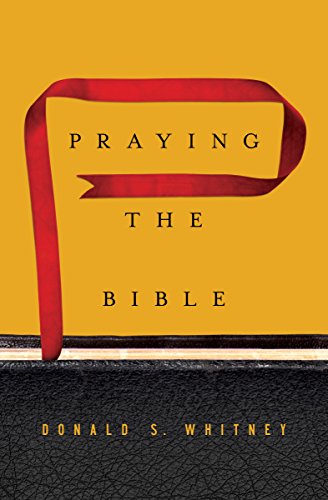
A Review of Praying the Bible by Don Whitney

NOTE: Since I haven't posted an article, or book review, in a while, it seems good to remind my few readers that in no way do I profit from these reviews. These are simply books that I feel have helped me either in my personal walk with God, or in ministry, or it has made me think about a topic in a different way. Dr. Whitney is not paying me for this paltry review, nor has anyone else. Enjoy!


Now, I love reading theology books. I love the nuance and the precision that it takes to nail down and explain certain doctrines or ideas. Yet, when I look at some of my books, I sigh, because there is simply no logical way that I will ever actually read the whole thing; they are simply too long.

I also love prayer. Wait, no. That's not quite true. I love the idea of prayer, but the reality is often lacking.  I lose my train of thought. Or what feels like  forever to pray was really only a few minutes. Or I sort of repeat the same things that I normally pray for and feel really discouraged by the whole thing. Because of this, my prayer life suffers, and every sermon or biblical text on prayer feels like the condemnation of a shameful dirty secret: a Christian who can't pray!

If you just so happen to feel the same way, then I would highly (is there another superlative that makes it more forceful? If there is, use that) recommend Praying the Bible by Donald Whitney.

Dr. Whitney is a professor at THE Southern Baptist Theological Seminary in Kentucky and he deals quite a bit with practical spiritual disciplines. His books on spiritual disciplines (both personal and corporate) are pretty good, but Praying the Bible is just too legit. Why? Well I'm glad you asked....

This book tackles a perennial problem, prayer. In a rather short book, only ten chapter clocking in at about 106 pages (including two indexes), Whitney packs a punch that, given the time it takes to read the book, should radically transform your prayer life. Now, before I start sounding like I'm selling a magic pill that cures cancer, let's break down the book:

Chapter one outlines the problem, and in chapter two Whitney gives the solution to a stale prayer life: praying through the Bible. in chapter three he gives the method for using the Bible as a guide to prayer (spoiler: it may not be just as you think). In Chapter four he deals a bit more with the method and chapters five and six deal with some good examples of praying through the Psalms and other biblical books. In chapter seven Whitney "forces" you to pray through a psalm, heavily suggesting that the reader stop reading until the exercise has been done. Chapter eight walks through common responses to his method. Chapter nine, barely a few pages, sums up the first chunk of the book before going to chapter ten, which covers historical examples of his method.

In my opinion, this book needs to be handed out to church members by pastors for free, until everyone in the congregation has at least one copy in each household. I cannot recommend this book enough for those who feel like their prayer life is stale, or even sadder, seemingly nonexistent. For those who will put in the work to actually practice this "revolutionary" method for rich prayers it pays dividends almost immediately.

The only real complaint that I have is that the book is too long. Whitney labors the point in a few places, seemingly repeating himself just to reach a minimum of pages by the publisher. This could have probably been an in-depth pamphlet and would have been just as eye-opening to read through.

Even with this minor thing, I would highly recommend this book to anyone and everyone who may happen to read this!

Friday, December 8, 2017

Review of The Distinctives of Baptist Theology

NOTE AND DISCLAIMER: I am a horrible theologian and I am even worse at summarizing complex theological systems in very short space, so take what I am writing here as a feeble best attempt, and buy the book so that you can get a much better explanation.

This short book (about 200 pages) written by Pascal Denault is a fantastic comparison between the two basic forms of covenant theology inside of what could be labeled as forms of Puritan federalism, which are ways of understanding how God has dealt with humanity through history. Mr. Denault (a French speaking Canadian Reformed Baptist Theologian) does a great job outlining the Presbyterian model of covenant theology and the Baptist model and does so from not only primary sources but  he uses  Scripture within the primary sources to highlight the differences between the two in favor of Baptist covenant theology.

Now I suppose I may need to back-up a bit and explain what in the world I'm talking about. Most of us know what a covenant is: a formal agreement between two (or more) parties who agree on certain stipulations and are expected to uphold their end of the agreement. The most notable biblical covenants would be the Mosaic Covenant and the New Covenant. In these covenants God says that He will do A as long as those benefiting from the covenant does B (or in the case of the New Covenant, Jesus does A and B on our behalf). These covenants, and others, are the basis of God's relations with humanity throughout  history according to Covenant Theology. This is over and against dispensation theology, in which God deals radically different with humans in each and every epoch of human history. To give a bit more of an example, Covenant Theology posits that God deals the same way with all humanity throughout time, and the covenants that pepper the biblical text and salvation history do not change how God deals with us. Dispensational theology would actually say that in any given epoch or dispensation of time, God deals with humanity (in terms of how one is saved) in very different ways. With this very truncated background of these two basic systems of how the Bible is laid out we can continue our talk about the book!

So Denault starts with covenant theology, which was the basic theological framework that theologians were operating with until the 19th century, and shows the internal struggle between English Dissenters during the 17th and 18th centuries between these two differing types of covenant theology.

The Presbyterian model essentially says that what we would call the Covenant of Grace was in effect and operating during the Old Covenant of Moses. This means that the people were saved under the Mosaic covenant as it related to grace as it was given through faith. When we get to the New Covenant under Christ we don't really have a new covenant, but a different version of the old one that had been in effect for thousands of years beforehand. This is the basic foundation of infant baptism within the Presbyterian churches(more or less, see the disclaimer at the top). Since all babies were brought into the covenant under Moses and then some had faith and were counted as believers and some were not, Presbyterians were able to justify infant baptism by recognizing that covenant still being in effect but viewed and administered differently under Christ. So where Israelites had unbelieving children inside the covenant community under Moses, Presbyterians can (possibly) have unbelieving children in the covenant community under Christ.

This model of covenant theology was not quite in jive with how the Baptists viewed the New Covenant under Christ. Hanging out extensively in Hebrews, Denault and the Baptists show that the New covenant under Christ is indeed a brand new covenant of grace that only those who will experience salvation can actually be members of the covenant community of believers. Basically the Covenant of Works was for Adam and the Garden of Eden where salvation was possible under following the Law that God had given him. The Mosaic Covenant (along with Abrahamic and Noahide and others) were shadows that pointed to and promised the Covenant of Grace, but did not bring it about. That was done by Christ on the Cross by His blood. The very newness of the New Covenant is so radically different from the Old that it makes sense that it is so new and special and could only do things that the old covenants pointed to, like actually saving those who were inside the covenant community, or to put another way, only those who are being saved (and nobody else) are inside the covenant, and therefore inside the covenant community.

Denault uses the actual writings exclusively from both Presbyterian and Baptist theologians from England during the 17th and 18th centuries to explain and show what each side believed without really putting words into either sides mouths. He deals fairly with both sides and quotes verbatim and simply reiterates what was already said quite clearly by both sides, even when they use Scripture to back up their claims. This book was a good, quick read (even for all the semi-heady concepts), and I would highly recommend it to anyone who has ever looked as a baptist church and a presbyterian church and wondered what the real difference was. This book helps explain probably the single biggest difference between the two groups. Denault did a very good job, and this book is definitely worth your time.

So if you want to actually understand any of what the book is really about, or if you want to argue with your Presbyterian friends and prove infant baptism as being biblically inconsistent, then pick up your own copy here.

Friday, October 6, 2017

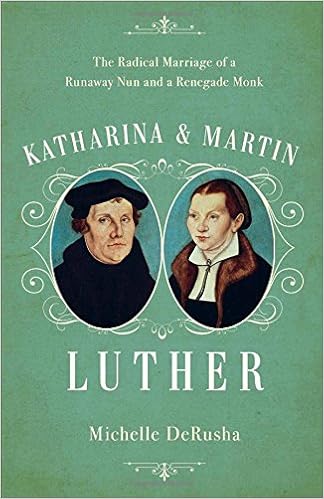
Review of Katharina & Martin Luther

Since it is Reformation month I thought that I would read and try to write a quick review of a book on the man who began the Protestant Reformation in force. Michelle DeRusha wrote this nice little book on the marriage of the Reformer, something which is often overlooked in most Reformation history. We tend to focus on the theology and the upheaval of the Reformation, because that is important. But DeRusha does an amazing job at showing why Luther's marriage to a runaway nun was so groundbreaking at that time. This focus shows how Luther's theology is fleshed out in everyday life, and it is a great reminder that our theology (because every Christian is a theologian) needs to be fleshed out and connected with the everyday and mundane of life.

With only 8 letters of Katharina (von Bora) Luther that has come down to historians there is a hard time to figuring out important things about her early life and the day to day of their marriage. There are copious amounts of letters from Martin (and correspondence among his friends) though, and a piecing together of their lives is possible and I believe that DeRusha does a fantastic job weaving their narrative together while showing little peeks at Luther's theology as it is developing along side some very important and interesting historical bits and bobs that shed even more light on what their lives might have been like. Things like late medieval pregnancy and delivery books to how the lives of women in convents was often very socially mobile really give a glimpse into something past the big theological and political climate that we are used to reading when we read Reformation history.

They say when doing something like this to list a positive, then a negative, then a positive. Here is my "negative". I really wish that it read a bit more like a narrative. It is a fantastic book that is filled with narrative sprinkled with historical asides that are fascinating and eye opening. But when I think of narrative-style history books I think of something that reads and feels like you are  instead of looking in from the outside. I think DeRusha tries to invite you into the Black Cloister (the Luther home, awesome name isn't it?) but I think that you are left in the parlour instead of welcomed in to sit at the table to experience a dinner with Martin Luther and all of the students and politicians and theologians eating and conversing with him.

Aside from that one thing, I think this is a fantastic book that also has the potential to show all of these major players at the beginning of the Reformation in a much more human light. They were groundbreaking theologians that were working on reforming the Church and taking her back to Scripture, but just like us they faced debt, bills, deaths of children, they had problem family members and went through human problems. They weren't simply theological machines. This book shows us that these major historical and theological players in one of the greatest and most trying moments in history were real people, and in the case of Martin and Katharina Luther, a real--and radical--marriage.

You can pick up your own copy here

Saturday, September 30, 2017

Review of Note To Self

This is the first book review that I'm doing for the blog. I probably won't do a very academic style book review, but keep it fairly short and sweet. I will also be taking these as an opportunity to show you guys maybe what we are reading over here and if we are able to utilize any of it in ministry. NOTE: We are not getting any sort of kick-backs from these reviews, we are not getting paid to write a review for any company and we don't get anything if you guys do decide to buy any of these books via the link provided. Thanks!

I have recently been binge-listening to the podcast Doctrine and Devotion, which is a SBC/reformed baptist pastor and a perennial elder-candidate talking about anything and everything in church life. Joe Thorn, the pastor and co-host, has written a few books, and I hope to review almost all of his here sooner or later, especially as I hope to maybe use some of them for future ministry training here in the Philippines.

Joe Thorn writes this book essentially to himself, something he says generally about his writing. He wrote this book with the discipline of preaching the Word to himself in mind.  This book is very devotional in nature, and the short chapters are perfect as short little daily devotionals in and of themselves. The point of the book is Thorn preaching to himself the Gospel over and over again in various forms, emphasizing various aspects of the Christian life, which in turn shows us a glimpse how to do that ourselves.

The 48 chapter book(let) is divided into three sections: The Gospel and God, The Gospel and Others, and The Gospel and You. Each small chapter begins with a passage of Scripture and then about a page and a half long note to Self about a specific topic like Love (Chapter 1), God Does Not Answer to you (Chapter 9), Hating Well (Chapter 28, and yes, you read that correctly), and many others. While I do wish that the chapters were a little bit longer to elaborate more on the topics and how to essentially preach them to myself, I understand that the purpose (and general writing of Joe Thorn) is to be short and to the point. In some ways that is part of what makes the book so handy. The shortness of the chapter allows you to have virtually the whole thing to mull over during the rest of your day, you don't really have to worry about forgetting a part of the chapter as you go throughout the day. You also don't have to fret about the chapter taking forever to remind why you need to love others or why you need to be reminded to hate the things that God hates.

I would highly recommend this book(let) if you are looking for a new devotional book, and are looking for something that can be challenging and shows you how to practice the art of preaching the Gospel to yourself. It is a very useful task in daily going through the task of checking your heart and testing yourself to make sure that you are indeed keeping the faith (2 Cor. 13:5). This book is a very valuable little way to help point you in a biblical direction for accomplishing such a job as checking your own heart.

You can get your own copy of the book here.